How to Improve Your Pump Track Skills: A Step-by-Step Guide
Learning to ride a pump track is relatively simple at the beginning: stay balanced, follow the circuit, and learn to move your body with the rollers. Getting faster and smoother is a different challenge. Progress on a pump track usually comes from improving technique. Practicing regularly at pump tracks in British Columbia or pump tracks in Alberta helps refine your body positioning. Small changes in body position, timing, vision, and speed control can make a noticeable difference. The good news is that you don't need to master everything at once. A better approach is to break riding into individual skills. For a broader skill overview, read our guide on pump track skill progression.
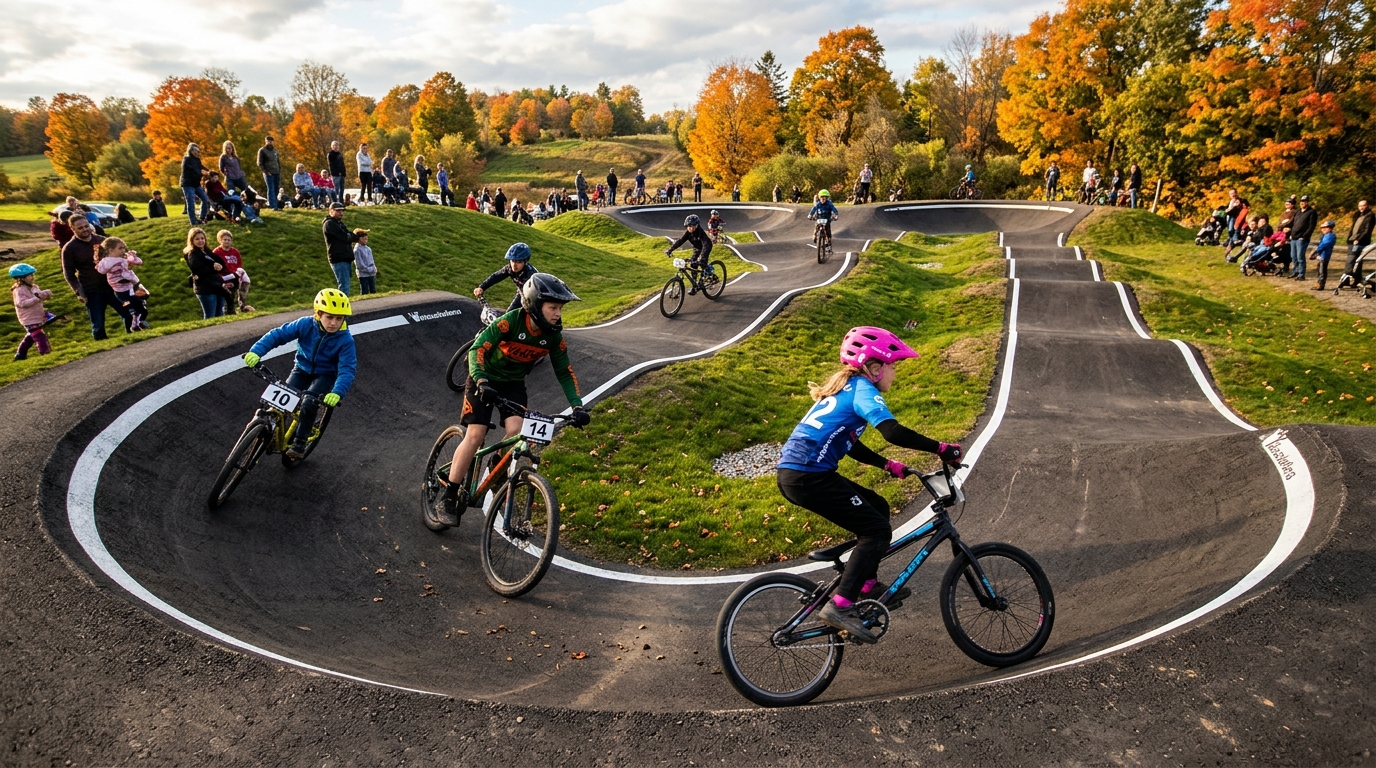
Start With Control, Not Speed
One of the most common mistakes riders make when trying to improve is focusing on speed too early.
Going faster doesn't automatically mean you're riding better.
If you're braking frequently, losing your line, bouncing through rollers, or feeling tense on the bike, adding more speed will usually make those problems harder to manage.
Instead, start at a pace where you feel completely in control, especially when riding fast asphalt circuits and pump tracks in Ontario or pump tracks in Quebec.
Your first objective should be consistency.
Can you complete several laps while maintaining a stable body position? Can you enter and exit berms without unnecessary braking? Can you move through rollers without becoming unbalanced?
Once those movements become more natural, speed can develop as a result of better technique.
Improve Your Riding Position
Your body position affects almost everything you do on a pump track.
Avoid locking your arms and legs completely straight.
Instead, keep your joints relaxed so your body can move as the track changes underneath you.
Your knees and elbows should have enough flexibility to absorb movement.
The exact position will change depending on the feature you're riding, so don't think of pump-track posture as a single frozen stance.
The important principle is adaptability.
You want to be able to move your body rather than allowing the bike to dictate every movement.
Look Further Ahead
Where you look has a major influence on how you ride.
Beginners often stare directly at the front wheel or the roller immediately in front of them.
That makes it harder to anticipate what comes next.
Try to look through the section you're approaching.
Before entering a berm, think about the direction of the turn. Before reaching a roller, prepare for the shape of the terrain rather than reacting at the last second.
Looking ahead gives your body more time to prepare.
It can also make your riding feel smoother because you're responding to the overall line rather than individual obstacles.
Learn the Pumping Motion
The fundamental skill of a pump track is, naturally, pumping.
The objective isn't simply to move your body up and down randomly.
Your movements should correspond with the shape of the track.
As you enter a transition or move into the lower portion of a roller, you can use your body position to apply pressure through the bike.
As you approach the crest, the movement changes and you become lighter on the bike.
The precise timing takes practice.
At first, it may feel unnatural. That's normal.
Rather than trying to generate maximum speed, concentrate on creating a smooth and repeatable movement.
Practise One Roller at a Time
If the entire track feels overwhelming, simplify the exercise.
Find a section with rollers that you can approach comfortably and concentrate on your movement through that section.
Try to maintain a consistent rhythm.
Notice whether you are:
- Staying balanced
- Looking ahead
- Moving your arms and legs naturally
- Maintaining contact with the bike
- Avoiding unnecessary braking
Repeating a small section can be more productive than completing dozens of uncontrolled laps.
Once the movement becomes familiar, apply the same technique to a longer section of track.
Work on Berms Separately
Berms are one of the most important features on many pump tracks.
A berm allows the rider to turn while maintaining momentum, but beginners often become uncomfortable when the track becomes steep or the direction changes.
Start with a comfortable speed.
Look toward the exit of the turn rather than staring at the inside edge.
Keep your body controlled and avoid sudden braking unless you genuinely need to reduce speed.
The objective isn't to take the corner as quickly as possible.
Instead, focus on entering smoothly, following a predictable line, and exiting with control.
As your confidence increases, you can gradually work on carrying more speed.
Avoid Excessive Braking
Braking has its place.
If you're going too fast to remain in control, reducing speed is preferable to taking unnecessary risks.
However, using the brakes constantly can make pump-track riding more difficult.
For example, braking unnecessarily in the middle of a berm can disrupt your balance and reduce momentum.
Instead of automatically reaching for the brakes whenever the track feels fast, practise entering sections at a speed you can manage.
This gives you more room to concentrate on technique.
Practise Riding With Your Feet Level
For riders using a bicycle with pedals, foot position can affect stability.
On many sections of a pump track, keeping the pedals level provides a stable platform and gives your body more freedom to move.
This can be particularly useful when learning to pump.
Don't treat this as an absolute rule for every feature or riding style. Experienced riders may adjust foot position depending on the situation.
For beginners, however, practising a stable pedal position can make the basic movements easier to understand.
Develop Better Speed Control
Good pump-track riders aren't simply fast.
They're able to control their speed.
That means understanding when to carry momentum and when to reduce it.
Try completing a lap at a deliberately comfortable pace.
Then repeat it while focusing on smoother transitions.
Instead of asking: “How fast can I go?” ask: “How smoothly can I ride this section?”
That change in mindset can be surprisingly useful.
Speed that comes from good technique is easier to control than speed created by simply pushing harder.
Build Consistency Before Difficulty
Once you've become comfortable on a particular track, it can be tempting to immediately search for a more difficult one.
There's nothing wrong with progressing, but consistency should come first.
Can you ride the same circuit several times without losing your rhythm?
Can you approach the same berm consistently?
Can you maintain your line?
Can you control your speed without unnecessary braking?
If the answer is yes, you're building a solid foundation.
The next step could be a different track, a more technical section, or simply working on speed while maintaining the same level of control.
Use Different Tracks to Develop Different Skills
Not every pump track provides the same riding experience.
Some have smaller rollers and gentle turns. Others may include larger features, steeper berms, jumps, or more complex layouts.
That variety can be useful as you progress.
A beginner-friendly track can provide a good environment for learning basic movement.
A more challenging track can introduce new demands once you're ready.
When exploring another facility, don't assume that your experience on one track automatically translates perfectly to another.
Take a few minutes to understand the new layout before trying to ride it quickly.
Record Your Progress
You don't need sophisticated equipment to evaluate your riding.
A friend can record a short video from a safe location away from the riding line.
Video can reveal things that are difficult to notice while you're riding.
For example, you might discover that you're:
- Looking down
- Standing too rigidly
- Braking unnecessarily
- Entering corners too quickly
- Losing rhythm over rollers
- Moving your body too late
You don't need to analyse every frame.
Look for one or two things to improve during your next session.
Take Breaks
More laps aren't always better.
Pump-track riding requires concentration and repeated body movement. Fatigue can affect coordination and decision-making.
If you notice that your technique is deteriorating, take a break.
This is especially important for children and beginners.
A shorter session where you remain focused can be more productive than continuing until you're exhausted.
Progress at Your Own Pace
There is no universal timetable for becoming a good pump-track rider.
People arrive with different levels of cycling experience, balance, confidence, and physical ability.
One rider may feel comfortable after a few sessions, while another may need considerably more practice.
Avoid comparing your progression to someone who has been riding for years.
Instead, measure improvement against your own previous sessions.
Maybe you can now complete a lap without braking.
Maybe your berms feel more controlled.
Maybe you can maintain momentum through several rollers.
Those are meaningful improvements.
A Simple Pump Track Practice Session
If you're looking for a structured way to practise, keep it simple.
First: Warm Up
Ride slowly and become familiar with the track. Don't worry about speed.
Second: Work on Rollers
Choose a comfortable section and concentrate on the pumping movement.
Third: Practise Berms
Concentrate on looking through the turn and maintaining a predictable line.
Fourth: Ride Complete Laps
Put the skills together without trying to go as fast as possible.
Finally: Identify One Thing to Improve
Choose a single technique for your next session.
This approach keeps practice focused without making riding feel like a complicated training program.
When Should You Move to a More Difficult Track?
There isn't a specific number of sessions you need to complete first.
Instead, look at your control.
You may be ready to explore a more challenging facility when you can comfortably manage the fundamentals of your current riding environment.
That could include maintaining balance, controlling speed, negotiating turns, and moving through rollers without repeatedly losing your line.
When you visit a new track, start conservatively.
Ride the layout at a comfortable speed before attempting larger or more technical features.
Safety Still Comes First
Improving your skills shouldn't mean ignoring safety.
Wear the protective equipment required by the facility and use additional protection if appropriate for your experience.
Follow posted rules and respect other riders.
Leave enough space to react to people ahead of you.
Don't attempt a feature simply because another rider makes it look easy.
And if a section is beyond your current ability, there's nothing wrong with skipping it.
Progress is much easier when you're able to keep riding consistently.
Frequently Asked Questions
Find Your Next Pump Track
Once you've developed confidence on one track, exploring another can be a great way to keep progressing.
Different layouts provide different challenges, and visiting facilities in other cities can expose you to new rollers, berms, surfaces, and riding environments.
Use the findpumptracks.ca to browse locations by province and city. Check individual listings before travelling, review the available facility information, and choose a track that matches your current experience.
The goal isn't simply to ride faster.
It's to ride with more control, better technique, and greater confidence — one lap at a time.