Pump Track vs. BMX Track vs. Skatepark: What's the Difference?
If you've searched for a place to ride and come across terms like "pump track," "BMX track," and "skatepark," it's easy to assume they're all interchangeable. In reality, each type of facility is designed around a different riding style, and knowing the difference can save you a wasted trip.
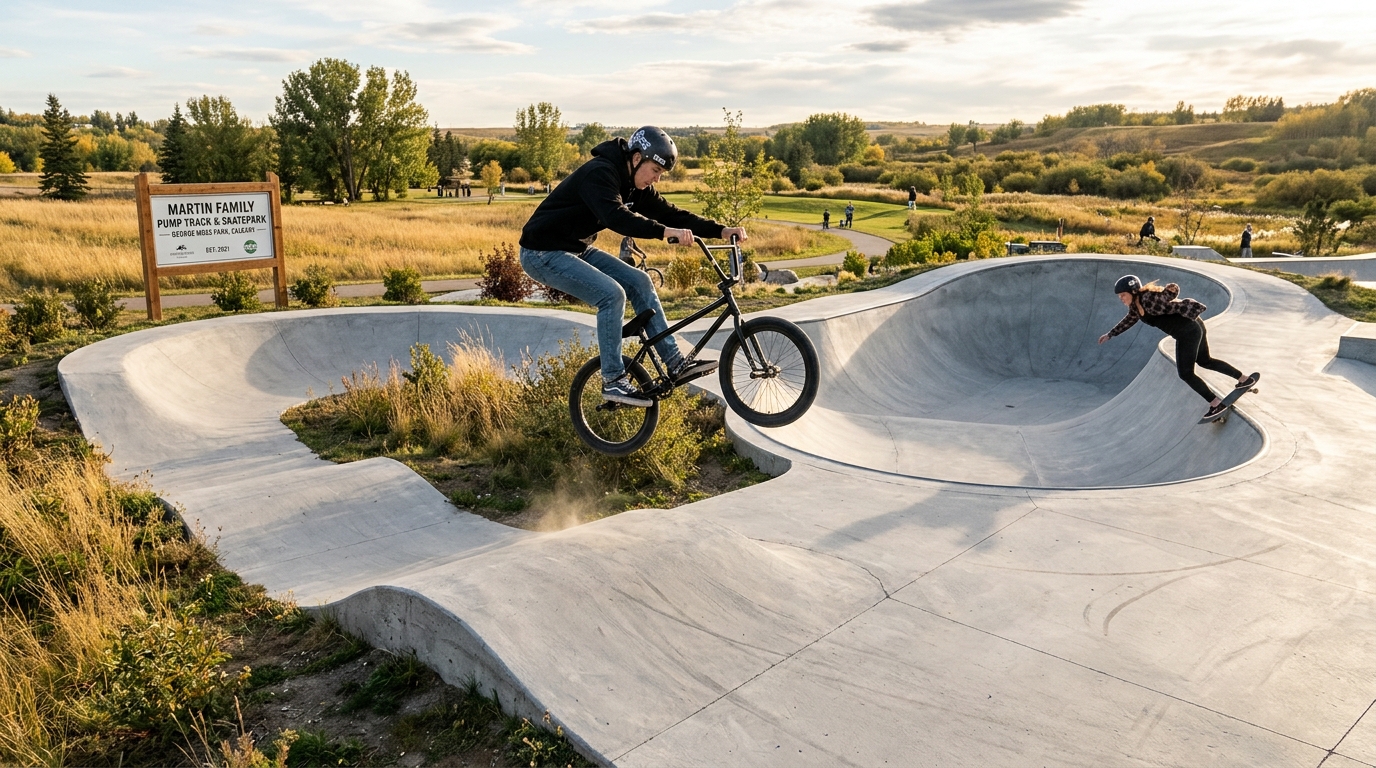
Pump Track: Momentum Without Pedalling
A pump track is a closed-loop circuit made up of rollers and banked turns called berms, sometimes combined with small jumps or technical sections. The defining feature of a pump track is that riders generate speed by shifting their body weight through the terrain rather than by pedalling continuously.
Pump tracks are typically compact, often fitting into a relatively small footprint compared to other riding facilities, which is one reason they've become popular additions to municipal parks across Canada (with premier pump tracks in British Columbia and pump tracks in Alberta). They're usually open to a wide range of equipment — BMX bikes, mountain bikes, balance bikes, and sometimes scooters — making them one of the more accessible riding facilities for beginners and families.
Best suited for: riders of all ages working on balance, cornering, and momentum control, from young kids on balance bikes to experienced BMX and mountain bike riders looking to fine-tune technique.
BMX Track: Built for Racing
A BMX track (sometimes called a BMX race track) is a purpose-built circuit designed specifically for competitive racing. Unlike a pump track, a BMX track usually includes a starting gate, a series of jumps often arranged in rhythm sections, and wider turns designed to accommodate multiple riders racing side by side.
BMX tracks are almost always dirt-based, since dirt allows for the shaping of larger jumps and rhythm sections that would be impractical to build in asphalt. Riding a BMX track well typically requires more experience than a pump track, since the jumps are larger and the racing format means riders are often navigating the course at higher speed alongside others.
Many BMX tracks are affiliated with a local cycling or BMX racing club, and some require membership or a scheduled session to ride, particularly during organized race nights.
Best suited for: riders with some existing bike handling experience who are interested in racing, jumping, and the competitive side of BMX.
Skatepark: Technical Features for Multiple Wheel Sports
A skatepark is designed around technical features rather than a continuous flowing circuit. Common elements include ramps, quarter-pipes, rails, ledges, stairs, and bowls — features built for tricks rather than lap-based riding.
Skateparks are generally shared spaces used by skateboarders, scooter riders, inline skaters, and BMX riders practising "street" or "park" style riding, which focuses on tricks over technical features rather than covering a circuit. Because skateparks bring together several different wheeled sports, etiquette and awareness of other riders are especially important.
Unlike a pump track, a skatepark doesn't have a single "correct" path to follow — riders choose their own line through the available features, which makes the space more freeform but also requires more spatial awareness to avoid collisions.
Best suited for: skateboarders, scooter riders, and BMX/mountain bike riders interested in tricks and technical features rather than lap-based riding.
Key Differences at a Glance
| Feature | Pump Track | BMX Track | Skatepark |
|---|---|---|---|
| Primary surface | Asphalt or dirt | Almost always dirt | Concrete or asphalt |
| Riding style | Continuous laps, no pedalling required | Racing, jumping | Trick-based, freeform |
| Typical users | All ages, multiple bike types | BMX/mountain bike riders | Skateboards, scooters, BMX |
| Skill level | Beginner-friendly | Intermediate to advanced | Varies widely by feature |
| Structure | Fixed circuit | Fixed circuit with start gate | Open layout, no fixed path |
Can One Facility Combine Several Types?
Yes — many municipal parks in Canada (with premier pump tracks in British Columbia and pump tracks in Alberta) combine two or more of these facilities in the same location, such as a pump track built next to a skatepark, or a BMX track located near a broader cycling park. This is worth checking when planning a visit, since a single trip might let you access more than one type of riding in the same area.
When browsing listings, pay attention to how a facility is actually described rather than relying on the name alone — some municipalities use "pump track" loosely to describe features that are closer to a small BMX track, or vice versa.
Which One Should You Start With?
If you're new to bike parks in general, a pump track is usually the easiest entry point. The lack of pedalling requirement, generally beginner-friendly layouts, and openness to different bike types make it a low-pressure environment to build fundamental skills like balance, cornering, and reading terrain.
Once you're comfortable with basic bike handling, a BMX track can be a natural next step if you're interested in racing or bigger jumps, while a skatepark can be a good option if you're more interested in technical, trick-based riding.
Frequently Asked Questions
Explore All Types of Riding Facilities Near You
Understanding the difference between a pump track, a BMX track, and a skatepark makes it much easier to choose the right facility for your riding goals — whether you're looking for a beginner-friendly circuit, a competitive racing environment, or a space to work on technical tricks.
Browse the findpumptracks.ca by province and city to find pump tracks near you, and check individual listings for details on nearby BMX tracks or skateparks that might round out your visit.