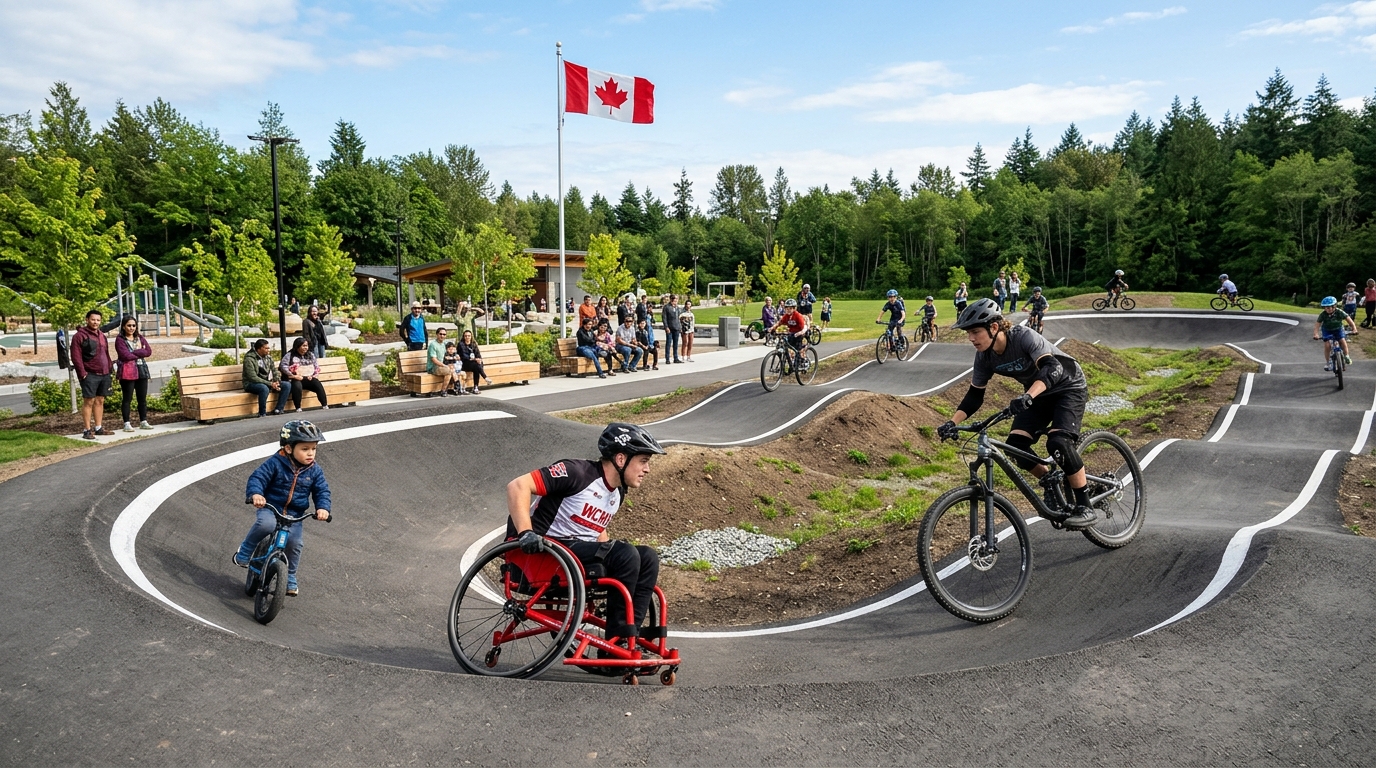
CANADIAN INDUSTRY ANALYSIS — Over the past five years, a quiet recreational revolution has swept across Canadian municipal planning departments. From rural townships in Quebec and Nova Scotia to booming suburban hubs in Ontario and British Columbia, Canadian cities have invested tens of millions of dollars into permanent, precision-engineered asphalt pump tracks, systematically replacing the aging wooden skateparks and dirt jump mounds of decades past.
What was once viewed by municipal officials as a niche novelty for BMX racers has rapidly evolved into an indispensable anchor of modern municipal park infrastructure. Today, over 220 public asphalt pump tracks operate across 10 Canadian provinces and territories, with dozens more currently in planning and construction phases for upcoming municipal capital budgets.
1. The Economic Calculus: Slashing Maintenance Overhead
The single most influential driver behind this municipal shift is long-term municipal cost management. Traditional dirt jump facilities, while relatively inexpensive to construct initially, impose staggering recurring maintenance costs on municipal parks departments. A dirt track requires frequent seasonal grading, extensive erosion remediation after heavy rainstorms, weed mitigation, and constant water compaction to prevent catastrophic rutting.
In contrast, engineered asphalt pump tracks require virtually zero routine structural maintenance. Once laid on a properly prepared, compacted gravel sub-base with frost-mitigating drainage, an asphalt track boasts an expected operational lifespan exceeding 15 to 20 years. When Canadian parks directors evaluate total cost of ownership across a 10-year horizon, asphalt pump tracks consistently prove to be among the most cost-effective capital investments a municipality can make.
2. Universal Inclusivity Across Ages and Wheels
A critical limitation of traditional skateboard parks was intimidation: steep concrete drop-ins, metal copings, and high vertical bowls frequently excluded younger children, beginner cyclists, and individuals with adaptive mobility equipment. Dirt jump parks similarly excluded anyone without knobby mountain bike or BMX tires.
Asphalt pump tracks completely dissolve these exclusionary barriers. Because momentum is driven entirely through body compression and extension over sinusoidal mounds, the speed of each rider is self-regulating. A three-year-old toddler on a wooden balance bike, an eight-year-old on a foldable kick scooter, an adult skateboarder practicing surf-skate carves, and a semi-pro downhill mountain biker can all share the same facility safely and harmoniously.
3. Canadian Climate Resilience: True Four-Season Usability
In Canada’s harsh, variable climate, recreation facilities that can withstand intense winter freezes, spring thaws, and summer heatwaves are paramount. Asphalt's dark pigmentation naturally absorbs solar heat, enabling pump tracks to melt snow and shed surface moisture weeks ahead of natural turf fields or forest trails. From early spring to late autumn, as soon as rainfall stops, high-friction asphalt surfaces dry within an hour, maximizing youth activity hours across our northern climate.
4. Sports Tourism and Economic Stimulus for Rural Communities
Smaller regional municipalities—such as Ayr (ON), Saint-Anselme (QC), Evansburg (AB), and Truro (NS)—have discovered that a world-class asphalt pump track serves as a magnet for sports tourism. Families and riding groups regularly embark on weekend road trips across provincial highways specifically to sample new track geometries, driving foot traffic to local gas stations, cafes, family restaurants, and sports retailers.
To explore the national distribution and discover facilities in your area, consult our comprehensive directory of Ontario pump tracks, British Columbia pump tracks, and Quebec pump tracks.